7 Factors that Affect the Cost of Commercial Solar Installation
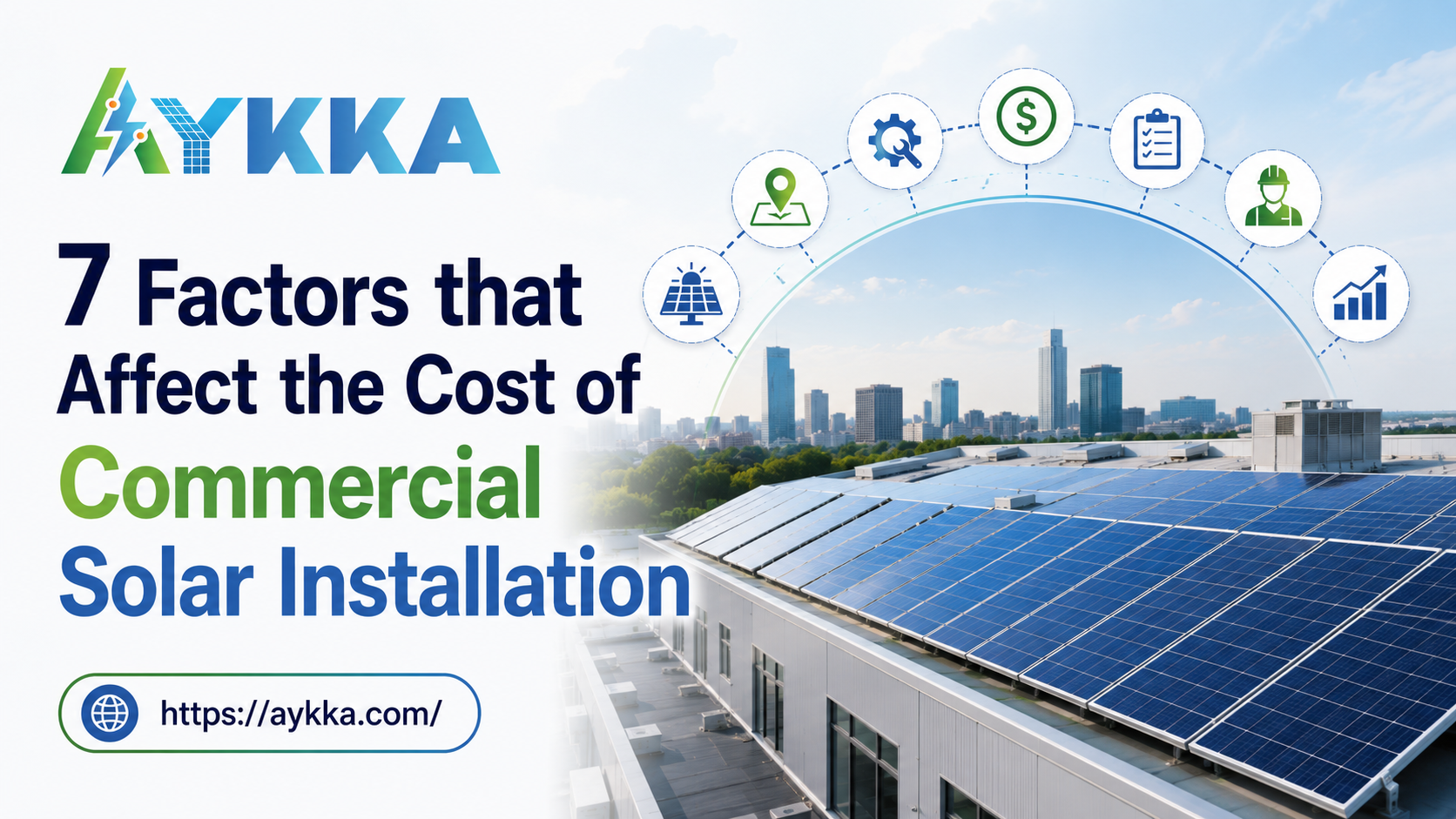
7 Factors that Affect the Cost of Commercial Solar Installation
If you run a factory, warehouse, showroom, or commercial property in Vadodara, electricity costs likely take up a large part of your monthly expenses. Power tariffs continue to rise, which is why many businesses are now evaluating the long-term value and cost of commercial solar installation before making an investment decision.
But one question comes up before anything else:
“How much does the cost of commercial solar installation actually come to for a business?”
There’s no single answer. The cost of commercial solar installation depends on multiple factors such as system size, panel quality, roof condition, electrical infrastructure, and government incentives.
A 50 kW rooftop system for a small manufacturing unit will cost far less than a 500 kW installation for a large industrial plant. Even two buildings with the same energy usage may have different project costs because of roof structure or grid connectivity.
This guide explains the main factors that affect commercial solar installation costs in simple terms, with examples relevant to businesses in Vadodara and Gujarat.
Many businesses also benefit from working with experienced solar panel manufacturers in Gujarat because local suppliers understand state regulations, subsidy approvals, and DGVCL connection processes.
Why Commercial Solar Costs Differ From One Business to Another?
Commercial solar projects are custom-designed. Unlike residential systems, business installations must handle larger electricity loads, industrial operations, and long-term savings goals.
For example:
- A textile factory in Makarpura GIDC has different power needs than a hospital in Vadodara city.
- A warehouse with a flat RCC roof requires different mounting structures than a sloped industrial shed.
- A company operating heavy machinery during daytime hours sees different savings compared to an office building.
Because of these differences, solar installation costs vary from project to project.
Below are the seven biggest factors that influence commercial solar pricing:
1. System Size and Electricity Consumption
The biggest factor affecting cost is system capacity, measured in kilowatts (kW) or megawatts (MW).
Larger systems cost more overall, but the cost per watt usually becomes lower because fixed expenses such as engineering, permits, transport, and labor get distributed across a larger setup.
Typical Commercial Solar Costs in Gujarat
- 25–100 kW systems: Around ₹18–₹30 lakh
Suitable for retail shops, SMEs, offices, and small factories - 100–500 kW systems: Around ₹40 lakh–₹1.2 crore
Common for manufacturing plants, schools, hotels, and institutions - 500 kW–2 MW+ systems: ₹1.5 crore and above
Used for large industrial facilities and logistics parks
Before deciding system size, review at least 12 months of electricity bills. This gives a realistic picture of energy usage.
Oversizing increases project cost unnecessarily. Undersizing reduces potential savings.
2. Type and Quality of Solar Panels
Solar panel selection directly affects both installation cost and long-term performance.
Higher-quality panels produce more electricity over time and usually come with stronger warranties.
Common Commercial Solar Panel Types
Monocrystalline Panels
- Higher efficiency, usually 19–22%
- Better performance in limited roof space
- Longer lifespan
- Higher upfront cost
These panels work well for older industrial plots in Vadodara where roof space is limited.
Polycrystalline Panels
- Lower cost
- Slightly lower efficiency
- Widely used across Gujarat commercial projects
Bifacial Panels
- Generate electricity from both sides
- Effective for ground-mounted systems
- Good option for open industrial land
For many businesses, investing in efficient panels reduces the number of modules required. This lowers mounting and structural costs while improving energy generation.
3. Mounting Structure and Installation Method
Installation type changes both material and labor costs.
Commercial solar systems are generally installed using one of these methods:
Rooftop Solar
The most common commercial option.
- Lower installation cost
- Faster approvals
- Best for factories and commercial buildings
Ground-Mounted Solar
Installed on open land.
- Better panel orientation
- Higher electricity generation potential
- Additional civil and foundation work required
Solar Carports
Panels installed above parking areas.
- Higher project cost
- Provides shaded parking
- Improves space utilization
In many Vadodara GIDC properties, flat industrial roofs use ballasted mounting systems, which avoid roof drilling. Older or fragile roofs often require additional structural reinforcement, increasing overall project cost.
4. Inverter Technology and Electrical Infrastructure
Solar panels generate DC power. Inverters convert this into usable AC electricity.
The inverter type affects efficiency, reliability, and project pricing.
String Inverters
- Most common in commercial projects
- Lower cost per kW
- Suitable for large, uniform rooftops
Microinverters
- Installed at panel level
- Better for shaded roofs
- Higher installation cost
Hybrid Inverters
- Compatible with battery storage
- Useful for backup power applications
Electrical infrastructure also affects pricing.
For example:
- Long cable routes increase wiring expenses
- Old electrical panels may need upgrades
- Additional switchgear and safety systems add cost
Many businesses underestimate these costs during initial discussions.
5. Location, Sunlight Availability, and Grid Connectivity
Vadodara and most parts of Gujarat receive strong sunlight throughout the year, averaging around 5.5 to 6 peak sun hours daily.
This improves solar energy production and reduces the system size needed to offset electricity bills.
Properties with easier DGVCL grid access usually face fewer approval delays and lower connection costs.
However, remote industrial locations sometimes require:
- Longer cabling
- Transformer upgrades
- Additional electrical work
These expenses alone add ₹2–₹5 lakh or more to a project.
6. Government Subsidies and Tax Benefits
Government incentives reduce the effective cost of commercial solar systems significantly.
Businesses in Gujarat benefit from several financial advantages.
Accelerated Depreciation (AD)
Companies claim up to 40% depreciation in the first year under income tax rules.
This improves cash flow and reduces taxable income.
GEDA Solar Schemes
The Gujarat Energy Development Agency occasionally provides rooftop solar incentives for eligible businesses.
Net Metering
Extra electricity generated by your solar system gets exported to the grid.
The exported units are adjusted against your electricity bill through DGVCL.
This improves ROI and shortens payback periods.
GST Input Tax Credit
GST-registered businesses claim input tax credit on:
- Solar panels
- Inverters
- Mounting structures
- Installation services
After applying available incentives and tax benefits, many commercial projects in Vadodara recover their investment within 4–6 years.
7. Installer Expertise and Project Soft Costs
Solar installation isn’t only about panels and inverters.
Soft costs usually account for 15–25% of total project value.
These include:
- Site surveys
- Structural audits
- Engineering design
- Permits
- Net metering approvals
- Earthing and lightning protection
- Monitoring systems
- Commissioning
An experienced local installer understands DGVCL approval procedures and Gujarat regulations. This reduces delays and avoids design mistakes.
Always ask for itemized quotations from multiple installers.
A lower quote sometimes excludes critical costs, which appear later during installation.
Estimated Commercial Solar Costs in Vadodara (2026)
Here’s a realistic pricing range for rooftop commercial solar systems before subsidies and tax benefits:
System Size | Estimated Cost | Average Payback |
50 kW | ₹22–₹30 lakh | 5–6 years |
100 kW | ₹40–₹55 lakh | 4–5 years |
250 kW | ₹90 lakh–₹1.2 crore | 4–5 years |
500 kW | ₹1.5–₹2.2 crore | 3.5–5 years |
Conclusion
The cost of commercial solar installation in Vadodara depends on several important factors, including system size, panel quality, roof structure, inverter technology, and available government incentives.
Businesses that invest in the right commercial and industrial solar setup reduce long-term electricity expenses, improve energy stability, and protect themselves from rising commercial power tariffs for the next 25 years.
Gujarat remains one of India’s strongest markets for commercial and industrial solar adoption because of high solar irradiance, supportive state policies, and strong industrial infrastructure.
Companies looking to optimize the cost of commercial solar installation while improving long-term ROI often work with Aykka Technovision Private Limited for project planning, engineering, installation, and energy-saving solar solutions designed for factories, warehouses, manufacturing plants, and commercial buildings.
Frequently Asked Questions
What is the average commercial solar cost per watt in Gujarat?
In 2026, most commercial solar systems in Gujarat cost around ₹38–₹55 per watt depending on project size, equipment quality, and installation complexity.
How does net metering work for businesses in Vadodara?
Under DGVCL net metering policies, excess electricity generated by your solar system gets exported to the grid. Those exported units reduce your electricity bill through energy credits.
Do commercial solar systems require batteries?
Most businesses use grid-connected solar systems without batteries because net metering already handles excess electricity efficiently.
Can businesses claim GST Input Tax Credit on solar projects?
Yes. GST-registered businesses claim input tax credit on solar equipment and installation expenses, reducing overall project cost.
What is the lifespan of a commercial solar system?
Most commercial solar panels come with 25–30-year performance warranties.