
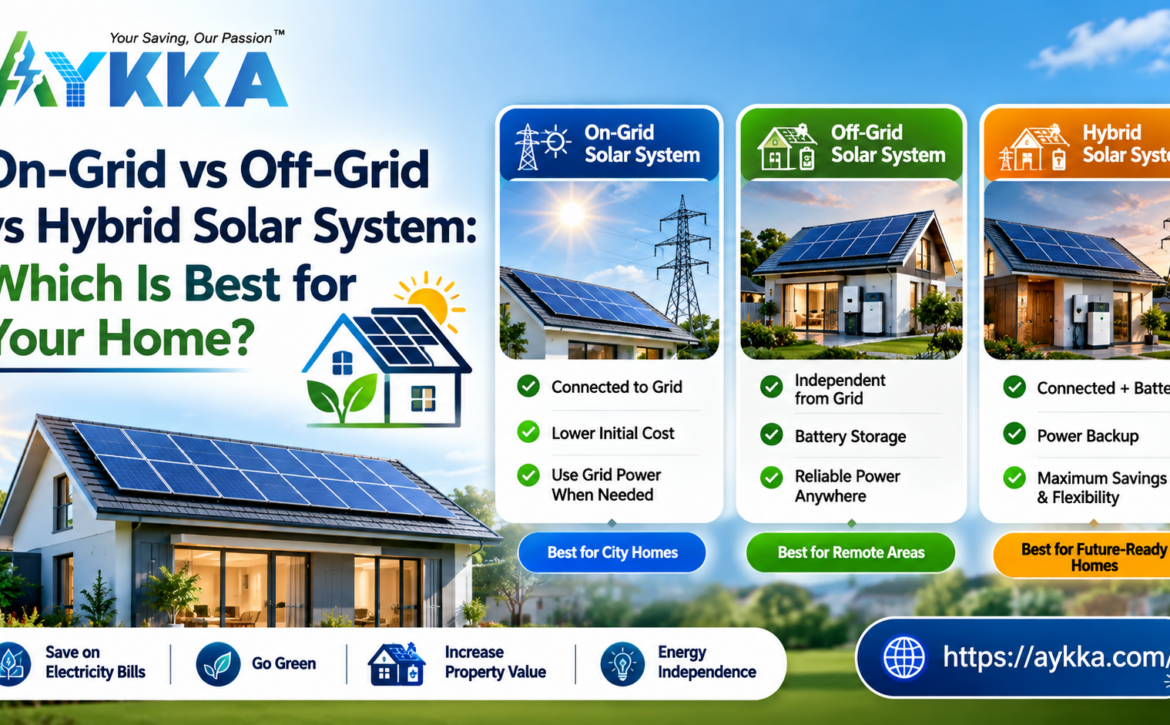
On-Grid vs Off-Grid vs Hybrid Solar System: Which Is Best for Your Home?
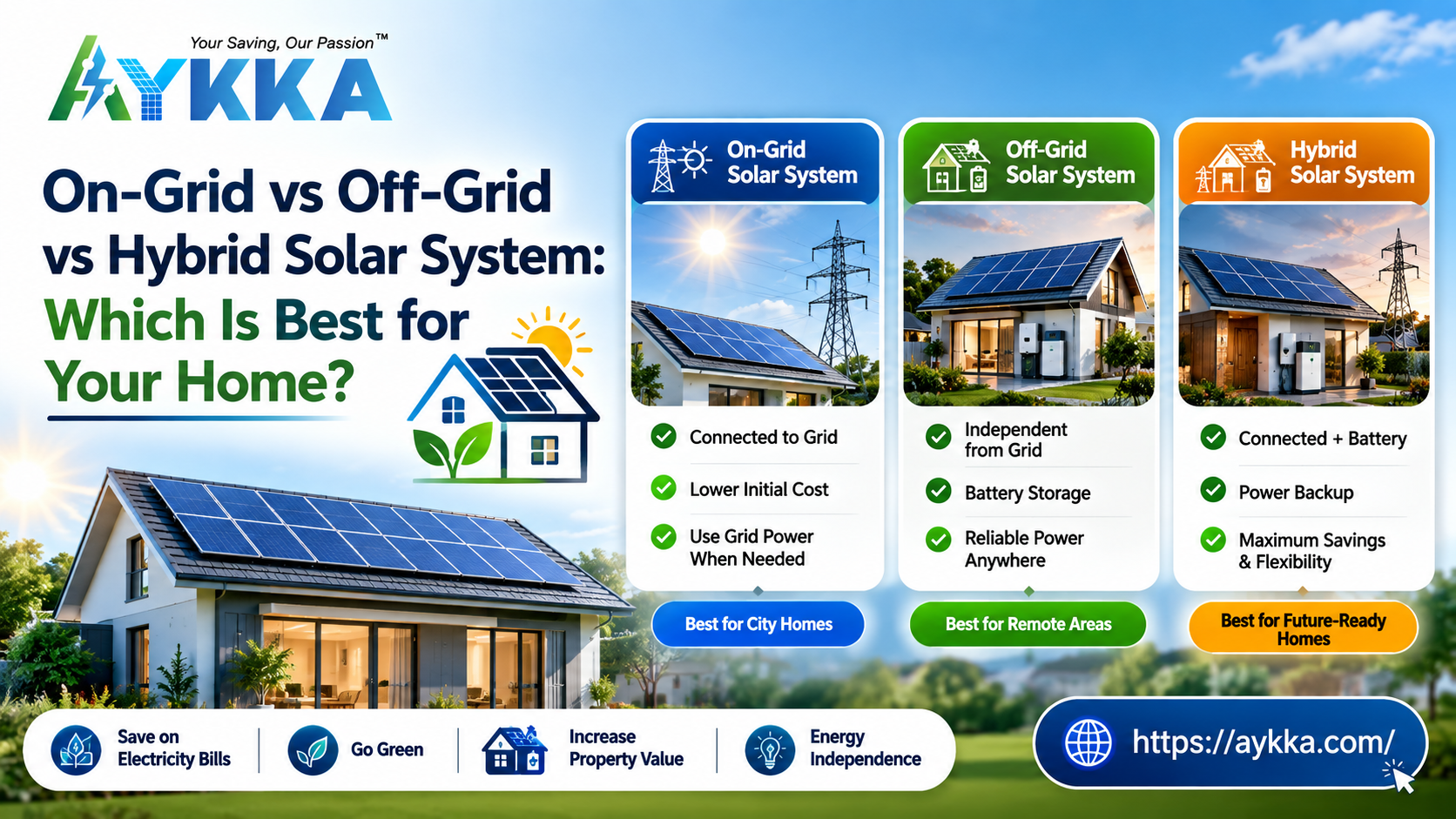
Choosing the right solar setup for your home often comes down to one key decision: on-grid vs off-grid vs hybrid solar system. They all generate electricity via solar panels, but when the panel’s production exceeds demand, they mix power grid dependence with battery storage and backup in case of a power cut. An on-grid system utilizes the utility grid to save money on a utility bill, an off-grid system runs independently with battery storage, and a hybrid system is a combination of solar, batteries, and grid electricity. Understanding these differences can help you choose a system that fits your electricity needs, budget, and expectations for backup and energy independence.
What Is an On-Grid Solar System?
An on-grid solar system, sometimes called grid-tied, stays permanently connected to the public electricity grid. There’s typically no battery. Your home draws from whichever source makes sense: solar when available, grid power when it isn’t.
The hardware is minimal:
- Solar panels generate DC electricity from sunlight
- A grid-tie inverter converts that DC power into usable AC
- The grid stays connected, both as backup and as an outlet for surplus power
During daylight hours, your home runs on solar first. Whatever you don’t use gets pushed back onto the grid, and some utilities credit you for it through net metering, depending on where you live. Once the sun stops producing enough, the switch to grid power happens without you noticing.
So what’s an on-grid system good for? Mostly, people with dependable grid access whose real goal is a lower bill, not backup power. These systems also shut down automatically when the grid goes down, a safety measure for utility crews. If the power goes out, your solar goes dark too, even in full sun.
See What Is an On-Grid Solar System? for more on inverter specs and net metering.
What Is an Off Grid Solar System?
An off-grid solar system runs entirely independent of the utility grid, with no fallback. It needs more equipment:
- Solar panels to generate electricity
- A battery bank to store what isn’t used immediately
- A charge controller to manage power flowing into those batteries
- An off-grid inverter to turn stored battery power into usable AC
The battery bank is the heart of the system. During the day, panels charge the batteries while powering the house. At night, or through cloudy weather, the home runs on what’s stored. If batteries drain faster than the sun refills them, there’s no grid to bail you out, which is why these systems tend to be oversized relative to daily use, and why people living with them stay disciplined about consumption.
This setup usually suits rural homeowners where running grid lines is expensive or impossible, along with anyone who wants energy independence on principle.
See What Is an Off-Grid Solar System? for more.
On-Grid vs Off-Grid Solar System:Key Differences
Side by side, it comes down to one question: does the system rely on the utility grid, or stand on its own?
Feature | On-Grid | Off-Grid |
Grid connection | Always connected | Not connected |
Battery requirement | Not required | Required |
Backup during outage | No, shuts off for safety | Yes, from batteries |
Excess electricity | Exported (where net metering applies) | Stored or unused |
Dependence on grid | High | None |
Installation | Simpler | More involved, needs battery sizing |
Best suited for | Stable grid, focused on lower bills | Remote homes, prioritizing independence |
The short version: on-grid leans on the grid to cut costs, while off-grid removes it entirely, at the cost of a bigger upfront investment and more hands-on management.
See On-Grid vs Off-Grid Solar System for a deeper comparison.
What Is a Hybrid Solar System?
A hybrid solar system is the middle ground: generation, storage, and a grid connection, working together.
Panels power the home first, then top up the battery. Once it’s full, leftover power can go back to the grid, depending on local rules. The battery cushions outages, while the grid backstops whenever solar and storage both fall short.
The upside is outage protection a plain on-grid system doesn’t offer, plus bill savings from staying grid-connected. The trade-off is cost and complexity, with more moving parts to size and configure. It suits homeowners who want savings and outage protection without going fully off-grid.
More on battery sizing and outage planning in What Is a Hybrid Solar System?
On-Grid vs Off-Grid vs Hybrid: Key Differences
Feature | On-Grid | Off-Grid | Hybrid |
Grid connection | Yes | No | Yes |
Battery | Not included | Required | Included |
Backup power | No | Yes | Yes |
Initial investment | Lowest | Highest | Moderate to high |
Independence | Low | Complete | Partial |
Maintenance | Low | Moderate to high | Moderate |
Ideal for | Stable grid areas | No grid access | Savings plus backup |
Long-term outlook | Tied to grid stability | Independence, periodic battery replacement | A balance of both |
No single row decides anything on its own. Usually it’s a combination of factors that points you toward one system.
Which Solar System Is Best for Your Home?
There isn’t a universal answer. What shapes the decision is grid reliability, electricity use, whether backup matters, budget once batteries are factored in, roof space, and maintenance.
As a rough starting point:
- Go on-grid if the main goal is a smaller bill and your local grid is generally dependable.
- Look at off-grid if grid access is unreliable, unavailable, or not worth connecting, and independence matters to you.
- Consider hybrid if you want savings and some backup power without going fully off-grid.
These are starting points, not guarantees. Savings and performance vary by usage, climate, equipment, and local rules.
Pros and Cons
On-grid costs less and is simplest to install, and where net metering is offered, it can lower your bill meaningfully. The catch: no power during outages.
Off-grid provides total independence with no need for grid-based availability. That price: the biggest initial expense, disciplined routines, batteries in regular need of care and servicing.
Hybrid brings backup power plus a shot at real savings, drawing from either the battery or the grid. What you give up is cost and simplicity.
Conclusion
None of these three systems beats the others on paper, it comes down to what your home needs. A dependable grid and a goal of lowering your bill points toward on-grid. Barely-there grid access, or wanting independence badly enough that price stops mattering, that’s off-grid territory. For people in between, hybrids usually end up being the pick.
Sort out your grid situation, budget, and how much backup matters before installing, and you’ll avoid paying for capacity you’ll never touch, or getting stuck without backup when you need it most. Choosing between on-grid, off-grid, and hybrid solar ultimately depends on your home’s specific requirements. With the right assessment and system design, Aykka Technovision Pvt Ltd helps homeowners choose solar solutions that balance energy savings, reliability, and long-term value.
Connect with @aykka_solar for solar ideas and updates.
Frequently Asked Questions
Is on-grid or off-grid solar cheaper?
On-grid is cheaper upfront since there’s no battery bank to buy. Off-grid costs more since it needs enough storage and panel capacity to cover your home alone.
Does an on-grid solar system work during a power outage?
No. It shuts down automatically when the grid goes out, as a safety measure for utility workers.
Can I add a battery to an existing on-grid system later?
Often, yes, though it depends on your inverter and whether it supports battery integration.
Is net metering available everywhere?
No. Policies vary by utility and region, and some areas don’t offer it at all. Check with your local utility first.
Which system is best for a home in a remote area?
Off-grid is usually the practical choice when grid lines are expensive or impossible to run. Hybrid can work too if some grid access is worth keeping as backup.