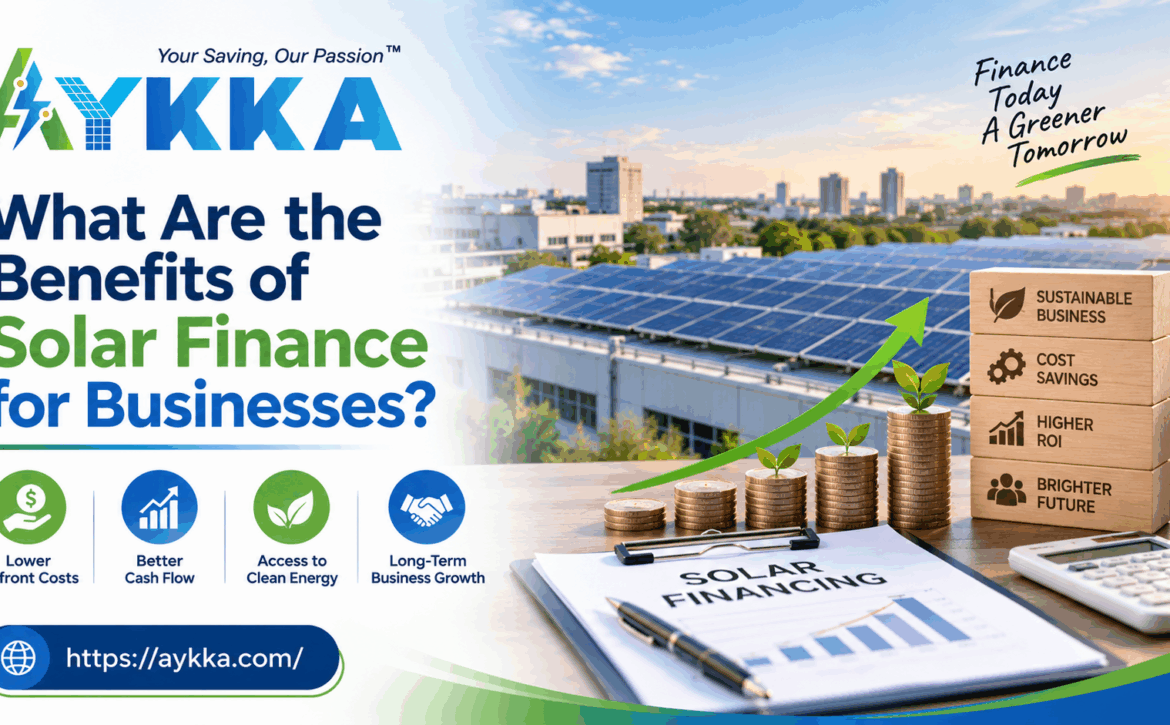
What Are the Benefits of Solar Finance for Businesses?

Electricity bills eat into margins in a way most business owners feel every month, and solar has become an obvious way to push back against that. But there’s a catch a lot of decision-makers run into almost immediately: installing a solar system on a factory roof, warehouse, or commercial property isn’t cheap, and paying for it in one go isn’t realistic for every business. That’s really the gap solar finance fills. It lets a business get the system installed and start saving on power without writing one enormous check upfront.
What Counts as Solar Financing for a Business?
At its core, solar financing just means paying for the installation over time instead of all at once. Rather than pulling the full project cost out of reserves, a business spreads that cost across a repayment period, ideally using part of what it’s saving on electricity (plus normal operating cash flow) to cover the installments.
A few structures come up most often. Term loans are the simplest: a lender funds the whole project and the business repays it in fixed monthly installments over a set tenure. Equipment or asset finance works a bit differently, with the solar hardware itself acting as collateral. And lease or subscription arrangements skip ownership entirely; a third party owns the system, and the business just pays to use the power it generates.
A handful of financing providers Aykka Technovision Pvt Ltd. is one example working directly with businesses on structuring these arrangements for commercial solar projects. Which structure fits best comes down to project size, cash flow, and how soon real savings are expected to show up.
What Are the Key Benefits of Solar Financing for Businesses?
Financing a solar installation instead of paying for it outright brings a handful of practical advantages worth weighing.
The most immediate one is lower upfront capital no need to pull a large lump sum out of reserves that could otherwise go toward operations, inventory, or expansion. It also makes cash-flow management easier, since spreading the cost through a solar loan or similar instrument lets monthly outflows line up with revenue instead of showing up as one big hit. Reserves stay intact too, which matters if a business wants a buffer for unplanned expenses.
Beyond that, there’s the electricity-cost side. A solar system reduces how much power a business pulls from the grid, often offsetting some or all of the monthly repayment. Repayments themselves are usually fixed too, which finance teams tend to appreciate given how much tariffs swing year to year, and financing can open the door to a better-sized system rather than whatever a smaller cash budget would allow.
Worth noting: financed solar assets may carry depreciation or other accounting benefits depending on jurisdiction (check with a financial advisor), and going solar financed or not supports sustainability and ESG goals without straining the capital budget.
How Does Solar Financing Affect Business Cash Flow?
Here’s the basic trade-off. Pay upfront and you take one large hit to cash on day one, with essentially no ongoing obligation after. Finance it, and that same cost breaks into smaller recurring payments but now there’s a repayment running for the length of the loan.
Whether that works in a business’s favour comes down to one comparison: how the monthly repayment stacks up against the electricity savings the system is expected to deliver. Land close to, or above, the repayment, and the financing barely dents cash flow. If there’s a meaningful gap, it’s worth asking whether the solar finance arrangement is structured right tenure and interest rate both play into that. It’s arguably the single most useful number to run before signing anything.
Solar Loan vs Paying for Solar Upfront
Factor | Financed via Loan | Paying Upfront |
Initial investment | Low to moderate (partial down payment, if any) | Full project cost paid at once |
Cash-flow impact | Spread across monthly repayments | One large outflow |
Repayment obligation | Fixed EMIs over the loan tenure | None after purchase |
Ownership | Usually owned by the business, subject to loan terms | Fully owned from day one |
Long-term cost | Higher overall, due to interest | Lower total cost, no interest |
Flexibility | Keeps cash free for other needs | Ties up capital in one asset |
Best suited to | Businesses prioritising cash-flow stability or with limited reserves | Businesses with surplus cash and no other pressing use for it |
Neither column is objectively “better” ; it really comes down to where a business sits financially and how it prefers to allocate capital.
What Should Businesses Check Before Choosing Solar Financing?
The financing terms and the project details both need scrutiny; they’re easy to treat as separate questions, but they interact more than people expect.
On the terms side: interest rate matters more than most people give it credit for, since even a small difference compounds over several years. Tenure is a trade-off shorter terms mean higher EMIs but less interest overall, longer terms ease monthly pressure but cost more. Beyond that, check for fees that quietly inflate the real cost, whether a down payment is required, and what the prepayment terms look like if the business wants to pay the loan off early.
On the project side, the monthly repayment only means something next to realistic projected savings not optimistic ones. Expected generation depends on site conditions, roof orientation, and shading as much as on system size, and the electricity tariff, current and future, shapes how much those savings are actually worth. Payback period, equipment quality (which affects performance long after the loan is settled), lender eligibility criteria, and who’s on the hook for maintenance once the system is running round out the list.
Is Solar Financing Suitable for Every Business?
Not really, and it’s worth saying that plainly. Financing tends to suit businesses that want to keep cash free for operations, are scaling and would rather not tie up capital in one large purchase, or have steady revenue that can absorb a fixed monthly repayment without strain.
It makes less sense for businesses sitting on surplus cash with nothing better to do with it paying upfront and skipping interest can work out cheaper over the system’s lifetime. Businesses with lumpy or seasonal cash flow should be careful too, since a repayment schedule that doesn’t match revenue timing creates pressure rather than relief. There’s no universally right answer; it comes down to each business’s own numbers.
How Businesses Can Evaluate the Financial Viability of a Solar Project
Whether financing it or paying outright, the same core numbers matter before signing off on anything.
Start with the total project cost of equipment, installation, and any related infrastructure, not just the panels. From there, look at expected annual generation; this varies more than people assume, since orientation and shading move the number as much as system size does. Compare that against current electricity spend for a real baseline, then work out expected savings honestly rather than optimistically inflated savings figures are where these calculations usually go wrong.
If financing is part of the plan, add in the financing cost (interest plus fees) and check the repayment period against how cash actually moves through the year. Payback period how long until savings cover the investment usually falls out of these numbers once they’re on the table. Last, think about long-term cash-flow impact, both while repayments run and afterward, once savings start landing without any offset.
None of this is worth much as a guess. Real quotes and an actual site assessment are what make the numbers usable.
Conclusion
The upfront cost is usually what stops businesses from going solar in the first place, and financing is a genuine way around that without draining cash reserves. It’s not a shortcut to guaranteed savings, though the real value of any project still comes down to system performance, electricity tariffs, and whether the repayment structure actually fits the business’s cash flow. Before committing, it’s worth putting the cost of solar finance side by side with the project’s real economics: expected generation, current electricity spend, and a realistic payback timeline. Get that comparison right, and the rest of the decision tends to follow.
Follow Aykka on Instagram for the solar tips & updates: https://www.instagram.com/aykka_solar/
Frequently Asked Questions
What is solar finance?
Solar finance refers to funding options that help homeowners and businesses pay for a solar energy system through loans, financing plans, or other payment solutions.
How does solar finance work?
Solar finance allows you to spread the cost of a solar installation over an agreed repayment period instead of paying the full installation cost upfront.
What are the benefits of solar finance?
Solar finance helps reduce the upfront cost of solar installation, supports better cash flow, and allows you to start using solar energy while paying for the system over time.
Who is eligible for solar finance?
Eligibility depends on factors such as your credit profile, income, project cost, and the requirements set by the financing provider.
Is solar finance worth considering for a solar project?
Solar finance is worth considering if you want to install solar without making the full payment upfront. Compare interest rates, repayment terms, fees, and total financing costs before choosing a plan.