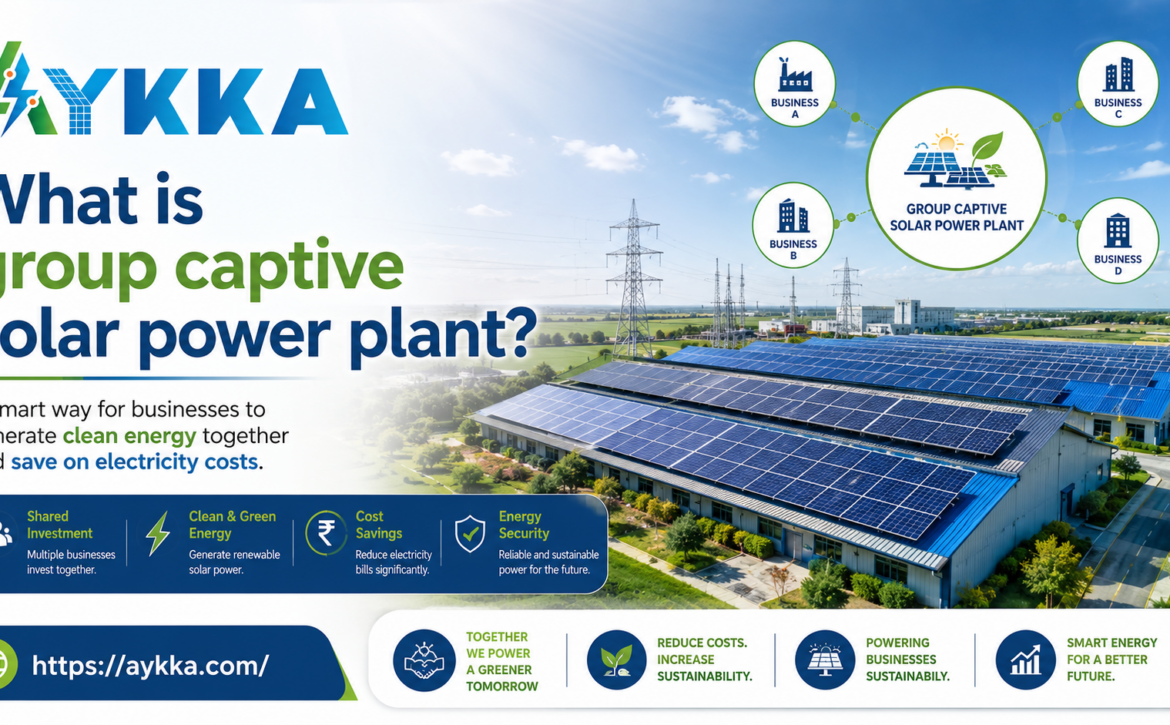
What is group captive solar power plant?
If you run a manufacturing unit or another electricity-intensive business, you probably look at your power bill differently from the average consumer. Electricity is not something you use occasionally. It is part of the cost of producing, storing, processing or delivering whatever your business does.That is why solar has become more than a sustainability conversation for many companies. It is also an energy-cost conversation.The difficulty is that putting solar panels on the roof does not always solve the whole problem. A factory may have a large electricity requirement but very little unused roof area. In some cases, the available land is needed for production, warehouses, parking or future expansion.
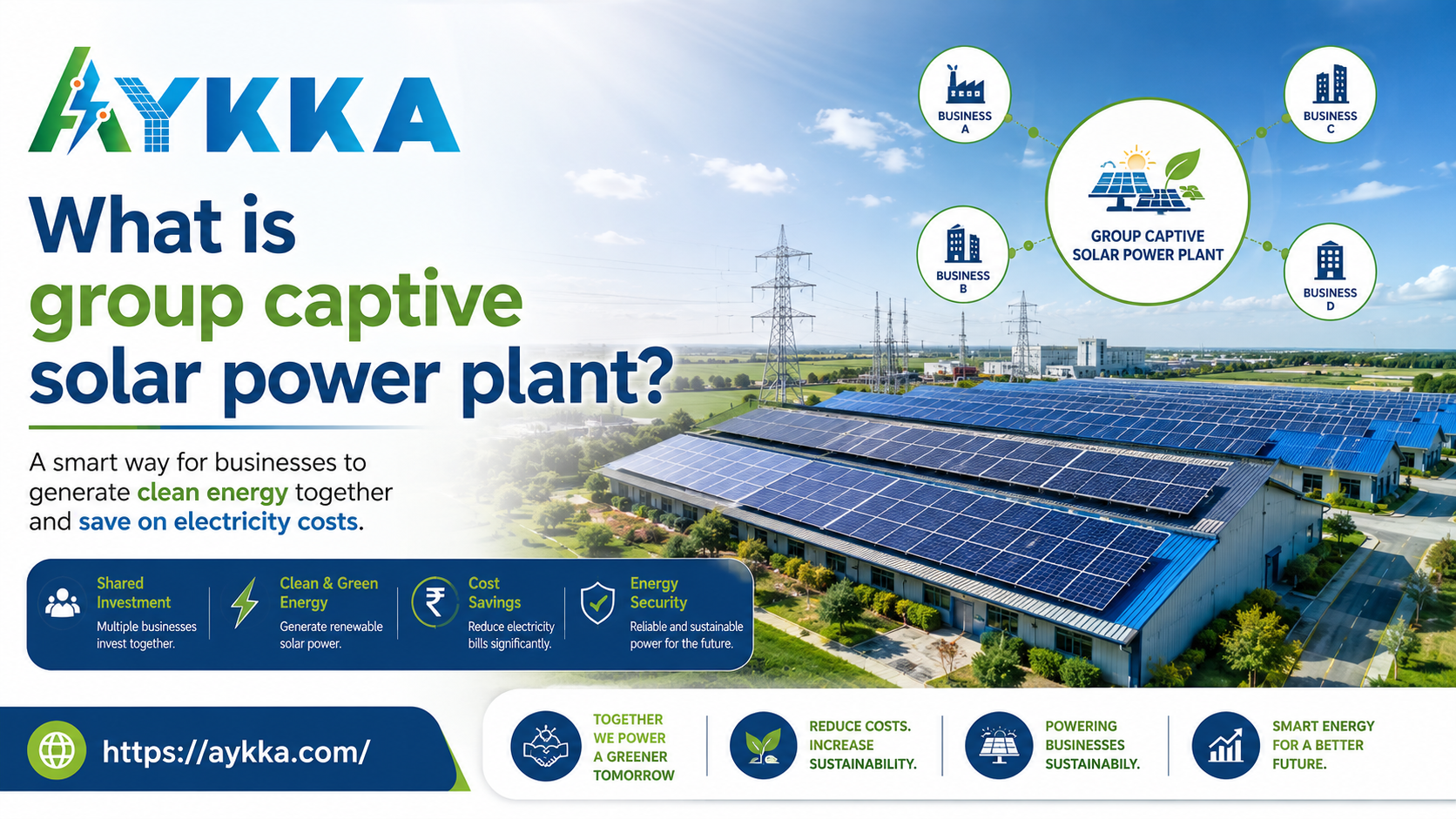
This is one situation where a group captive solar power plant can be worth looking at.The basic idea is quite straightforward: what is group captive solar power plant in practice? Instead of one company building a large solar plant entirely on its own, a group of eligible electricity consumers participates in a common project. The consumers have an ownership interest in the project and use the electricity generated by it, subject to the applicable captive power regulations.The plant can be located away from the factories that consume its electricity.That one point explains much of the appeal of the model.
What Is Group Captive Solar Power Plant and How Does It Work?
It is a solar power project in which eligible electricity consumers collectively hold ownership in the generating project and consume the electricity produced by it for their own use.
The solar plant is usually developed at a location where a large project can be built with suitable land, solar resources and grid connectivity. The participating businesses do not have to install the entire generating capacity at their own premises.
That is an important distinction.
A business buying renewable electricity from a solar generator is not automatically participating in a captive project. In a captive structure, ownership and consumption are part of the arrangement.
A simple way to picture it is this:
Several businesses invest in one solar project → the project generates electricity → the participating businesses consume that electricity through the applicable grid arrangement.
It is essentially a shared solar asset designed around the electricity needs of its participating consumers.
Why Would a Company Need This Model?
Consider a typical industrial situation.
A company operates a factory that consumes a large amount of electricity every month. Management wants to increase its use of solar power, but there is a problem: the factory does not have enough suitable space to install a solar plant large enough to cover a meaningful part of its electricity requirement.
Building a separate solar farm elsewhere could solve the space problem, but doing that alone means taking on the entire project investment and responsibility.
A group captive arrangement offers another route.
The company can participate in a larger solar project along with other consumers. The plant can be located at a suitable site, while the electricity is delivered to the participating facilities through the electricity network under the relevant open-access arrangements.
For businesses with substantial power consumption, that can make the idea of off-site solar much more practical.
How Does the Captive Solar Project Work?
There are several legal, financial, and technical details behind every project, but the basic flow is easier to understand than it first appears.
Businesses become participating consumers
The process starts with electricity consumers that want to participate in a common renewable energy project.
Their electricity consumption is important because the captive framework is not based on ownership alone. The amount of electricity consumed also matters.
An SPV generally owns the project
A Special Purpose Vehicle, or SPV, is commonly established for the project.
The SPV becomes the entity through which the solar plant is developed and owned. Participating consumers hold equity in it according to the project’s structure.
This is one of the main differences between a captive ownership structure and an ordinary power purchase agreement.
The Plant Is Set Up at a Suitable Location
The project developer takes care of the practical side of developing the plant: land, engineering, solar modules, inverters, evacuation infrastructure, grid connectivity, construction and commissioning.
The location does not have to be next door to the consumer.
In fact, the ability to use a suitable off-site location is one of the reasons businesses consider this model.
Electricity is generated and transmitted
Once the plant is operational, solar energy is converted into electricity and injected into the grid.
The electricity then moves through the applicable transmission and distribution network to the participating consumers.
This involves the relevant approvals, metering, scheduling and open-access arrangements.
The participating consumers use the electricity
The businesses consume the power for their own operations.
At this stage, the question becomes less about the solar panels themselves and more about the economics of the electricity being delivered to the factory or facility.
That is ultimately what a business needs to evaluate.
What Makes a Solar Plant “Captive”?
This is where the model becomes different from simply buying green electricity.
India’s captive generating plant framework includes specific requirements relating to ownership and consumption. The Electricity Rules were amended in 2026, so project-specific ownership, consumption and compliance requirements should be verified under the rules applicable to the project.
These two numbers are worth remembering because they explain why the ownership structure matters.
It is not enough for a business to say that it is using solar electricity. The project needs to meet the conditions prescribed for captive generation.
The rules also contain provisions concerning captive users, generating plants, SPVs and how ownership and consumption are assessed. The regulatory framework has been amended over time, so the exact requirements applicable to a new project should always be checked at the time of investment.
For a business considering the model, this means the regulatory side deserves the same attention as the financial side.
Where Does the Financial Advantage Come From?
This is probably the first question most business owners or finance teams will ask.
The answer is not simply “solar is cheaper.”
The economics depend on the complete structure of the project.
A business normally has an existing electricity cost. That cost may include energy charges and several other components depending on the connection, location and applicable tariff structure.
With this type of captive project, the business needs to understand what its renewable electricity will actually cost after considering the project investment and applicable charges.
Depending on the project and state, the calculation may include:
- Cost of the solar project
- Financing cost
- Operation and maintenance
- Transmission charges
- Wheeling charges
- Banking-related charges, where applicable
- Surcharges
- Taxes
- Grid and evacuation costs
- Other statutory or project-specific charges
This is why comparing a quoted solar generation rate with the headline electricity tariff can be misleading.
The useful number is the effective delivered cost of electricity.
If that number is attractive compared with the business’s existing power cost, the project may make commercial sense.
If it is not, the fact that the electricity is solar does not automatically make it a good investment.
The Land Advantage Is Easy to Overlook
A factory’s land is valuable.
If a company owns a large industrial site, that land may already have a job. It might be occupied by production lines today or reserved for an expansion planned three years from now.
A solar installation competing with those requirements can become difficult to justify.
A remote solar project changes the equation.
The company can participate in a much larger solar installation without turning its own premises into a solar farm.
For businesses with high electricity consumption and limited available space, this can be a significant practical consideration.
Rooftop Solar and Off-Site Solar Projects: Key Differences
Both models use solar power, but they suit different circumstances.
Rooftop solar is physically connected to the consumer’s premises. It works particularly well when a business has a suitable roof, predictable daytime consumption and enough space for the required capacity.
Rooftop Solar | Off-Site Captive Solar | |
Plant location | Consumer’s site | Usually off-site |
Ownership | Usually individual | Shared among participating consumers |
Scale | Limited by available site | Can be utility/megawatt scale |
Large land requirement at factory | Yes, if ground-mounted | No |
Power delivery | Mainly on-site | Through applicable grid arrangements |
Investment | Individual project | Shared/project ownership |
Typical consideration | Available roof/land | High demand and limited on-site space |
This does not mean one model is better than the other.
A company with a large, suitable rooftop may have no reason to complicate things with an off-site project.
Another company may have a huge electricity requirement and almost no spare space. For that business, an off-site captive arrangement deserves a closer look.
What About Open Access?
The terms captive generation and open access are often mentioned together, which can make the subject confusing.
They are related, but they do not mean the same thing.
Open access refers to the use of the electricity network to access power from a source other than the conventional supply arrangement, subject to the applicable rules, approvals and charges.
Captive generation refers to the ownership and consumption structure of the generating plant.
An off-site captive project can use open-access arrangements to deliver electricity to its participating consumers.
So, one describes the ownership relationship, while the other describes the way electricity is accessed and transported through the network.
That distinction becomes important when a business compares different renewable power options.
Who Should Consider This Solar Model?
There is no magic electricity-consumption number that makes a company automatically suitable.
However, the model is generally more relevant to businesses that use substantial amounts of electricity and expect that requirement to continue over the long term.
This can include:
- Manufacturing plants
- Textile units
- Engineering companies
- Automobile and component manufacturers
- Chemical and processing industries
- Large warehouses
- Commercial facilities
- Hospitals
- Educational institutions
- Corporate facilities
- Other high-consumption businesses
The actual suitability depends on the consumer’s location, electricity profile, tariff, project structure, applicable regulations and financial objectives.
A small office with modest electricity consumption may not need this level of complexity.
A factory operating energy-intensive machinery for long hours is a very different case.
What Are the Risks or Challenges?
A good business decision should look at the inconvenient parts as well as the attractive ones.
The first is regulatory compliance.
The project has to satisfy the applicable captive ownership and consumption requirements. These cannot simply be assumed to remain unchanged throughout the life of the project.
Then there is the electricity network.
The solar plant may be hundreds of kilometres away from the factory. The electricity still has to travel through the grid, which means connectivity, transmission, wheeling, metering and scheduling all matter.
Solar generation itself is also variable.
A plant does not produce exactly the same amount of electricity every day. Weather, season and solar conditions influence output.
There is also the question of multiple participants.
When several companies share ownership of a project, the agreements between the parties become important. A prospective participant should understand its investment commitment, consumption expectations, responsibilities, exit provisions and what happens if its electricity requirement changes.
None of these issues makes this renewable energy model unattractive.
They simply mean that it should be treated as a long-term energy investment rather than a straightforward equipment purchase.
What Should a Business Check Before Investing?
Before signing up for a group captive project, a company should start with its own electricity data.
Look at the previous electricity bills. Understand annual consumption, monthly variations, peak demand and production patterns.
Then calculate the current effective cost of electricity.
After that, compare it with the proposed renewable arrangement.
A few practical questions are worth asking:
1. How much electricity will the project actually generate?
The expected annual generation is more useful than simply knowing the plant’s installed capacity.
2. What will the delivered cost be?
Include the applicable transmission, wheeling, banking, surcharge, tax and other costs.
3. What ownership will the company hold?
The business should clearly understand its equity position and how it relates to the captive requirements.
4. What happens if consumption falls?
A factory may have an unexpected shutdown or a production slowdown. The implications should be understood beforehand.
5. Who is responsible for operations and maintenance?
A solar project is intended to operate for many years. Long-term performance depends on more than the initial installation.
6. What happens if regulations change?
Electricity policy is not static. The commercial model should be evaluated with appropriate regulatory diligence.
Is This Captive Solar Model Worth Considering?
For the right business, yes.
But “right business” is the important part.
This model is not automatically the cheapest renewable option for every company. Nor is it automatically better than rooftop solar or another open-access arrangement.
It becomes particularly interesting when three things come together:
The business consumes a lot of electricity.
The business cannot install enough solar at its own premises.
The business is prepared to make a longer-term commitment to renewable power.
When those conditions exist, an off-site solar project can solve a problem that rooftop solar cannot.
The next step should then be a proper commercial assessment rather than a decision based on a headline savings percentage.
Conclusion
The easiest way to understand group captive solar is to stop thinking of it simply as “buying solar power.” It is a different way of structuring renewable energy procurement.
A group of businesses participates in a solar generating project, takes the required ownership interest, and uses the electricity produced by that project. The plant can be developed at a location that is more suitable for large-scale solar, while the participating businesses receive the electricity through the applicable grid arrangements. For a company with high power consumption, that can be an interesting alternative to relying entirely on conventional electricity or trying to fit a very large solar installation onto its own premises. But the numbers need to make sense.
The right decision comes from looking at the company’s actual consumption, current power cost, proposed project economics, ownership structure and regulatory requirements together. Businesses exploring this model can learn more about AYKKA Technovision Private Limited, which is designed around large-scale solar generation and an SPV-based ownership structure for participating consumers. Visit Aykka to learn more about group captive solar solutions.
Follow @aykka_solar for useful solar tips and project updates.
Frequently Asked Questions
What Is the Difference Between Group Captive and Open Access?
Group captive involves shared ownership of a power project, while open access allows eligible consumers to buy electricity from a power producer through the grid.
What Are the Top 5 Solar Power Plants in India?
The top 5 solar power plants in India include Bhadla Solar Park, Pavagada Solar Park, Kurnool Ultra Mega Solar Park, Rewa Ultra Mega Solar Park, and Khavda Renewable Energy Park
What Is the 20% Solar Rule and How Does It Work?
The 20% solar rule generally refers to a guideline requiring a certain share, often around 20% of a consumer’s electricity consumption or contracted load to be met through solar power, depending on the applicable policy or project structure.
Can a 3kW Solar System Efficiently Run a 1.5-Ton AC?
Yes, a 3kW solar system can run a 1.5-ton AC, especially during sunny hours, but actual performance depends on the AC’s power consumption and other connected loads.
Which Type of Power Plant Offers the Highest Efficiency?
Combined-cycle gas power plants are generally among the most efficient conventional power plants, while solar and wind plants have no fuel-related thermal efficiency.