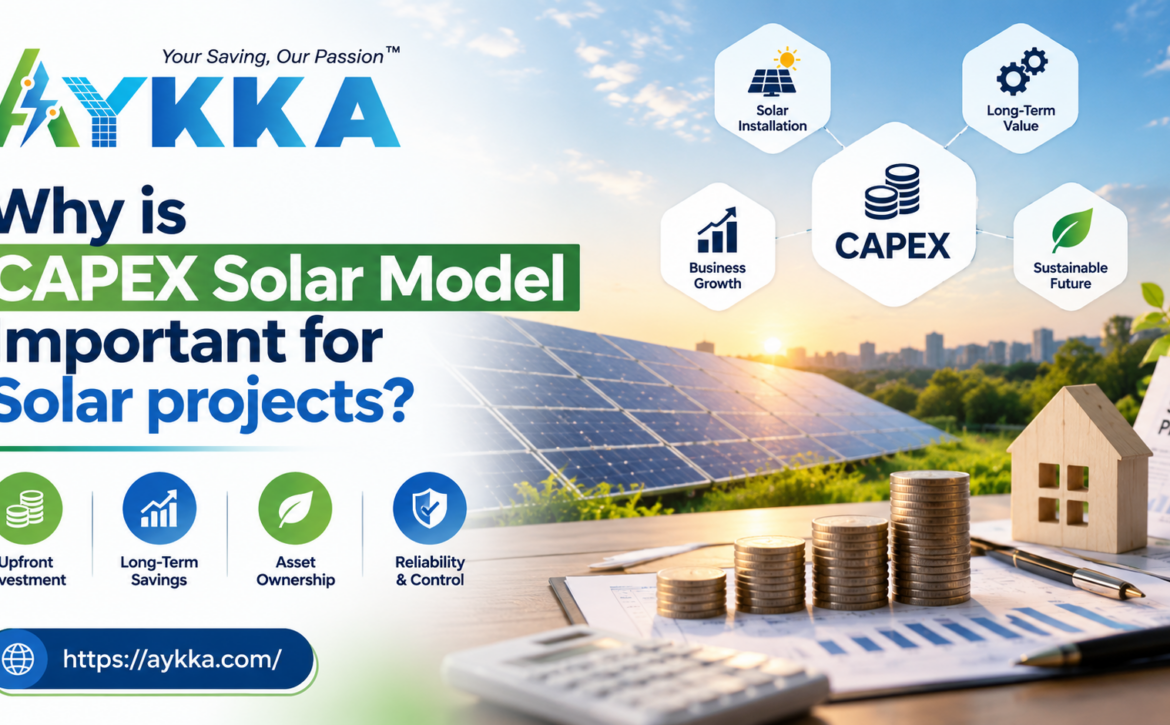
Why is CAPEX Solar Model Important for Solar projects?

Most businesses looking into rooftop or ground-mounted solar hit the same fork in the road, usually earlier than they expect. Do you pay for the system yourself and own it outright, or let a developer put up the money and own the plant while you simply buy the power? It sounds like a financing detail. It isn’t. That one decision quietly shapes your cash flow in year one, your savings in year fifteen, and how much say you actually have over the asset in between. This is the essence of the CAPEX solar model, and it’s worth understanding properly before any capital gets committed, not after.
What Is a CAPEX Solar Model?
CAPEX is short for capital expenditure, money spent upfront to acquire something that’s meant to last. In solar, that “something” is the power plant itself. Under this model, the business funds the design, equipment, and installation directly, whether that’s from cash reserves or a loan. Once the system is commissioned, it belongs to the business. Not to a developer, not to anyone else.
That single fact changes the economics more than people expect. The upfront cost usually covers the panels, inverters, and mounting structures; cabling and protection equipment; installation and commissioning; and, where relevant, grid-interconnection or metering charges.
Because the business owns the asset, it also owns the risk and the upside that comes with it. There’s no monthly power purchase agreement sitting in between. The plant just offsets whatever electricity would otherwise be bought from the DISCOM, and the savings land directly with the business for as long as the system keeps performing well.
How Does the CAPEX Model Work for a Solar Project?
No two projects follow an identical path, but the rough shape tends to repeat: a site assessment (roof strength, shading, orientation, available space), system design matched to actual load patterns, cost estimation, a decision on financing, installation itself, any DISCOM or net-metering approvals, commissioning, and then the long stretch of generation and upkeep.
A modest rooftop on a straightforward site can move through all of this in a few weeks. A larger industrial site with structural reinforcement needs, or a slow DISCOM approval process, can take a lot longer. Either way, it helps to think of CAPEX as a sequence of decisions rather than a single upfront transaction because that’s really what it is.
Why Does CAPEX Matter?
CAPEX matters because the business owns the solar system and keeps the benefits it generates. It can reduce grid electricity costs over time, provide greater control over the asset, and may offer depreciation benefits under applicable tax rules. For businesses with stable power demand and long-term site plans, ownership can make the investment more valuable over the system’s operating life.
CAPEX vs OPEX: Which One Actually Fits?
This is the classic opex vs capex question, and honestly, there’s no clean universal answer. It comes down to how much capital is available, how much risk the business is willing to carry, and how long it expects to stay put at that site.
Factor | CAPEX | OPEX |
Upfront investment | Higher, borne by the business | Minimal to none |
Asset ownership | Business owns the system | Developer typically owns it |
Maintenance responsibility | Business (in-house or outsourced) | Usually the developer/RESCO |
Long-term savings potential | Generally higher over system life | Lower, since power is purchased at a fixed rate |
Operational control | Full control with the owner | Limited, per agreement terms |
Best suited for | Long-term site tenure, available capital | Limited capital, shorter-term occupancy |
The opex model in solar tends to make more sense when capital is genuinely tight, site tenure is uncertain, or a business would rather not deal with maintenance at all. There’s also a middle ground worth knowing about BOOT structures, where a developer builds and operates the plant for a set period before ownership eventually transfers to the business.
What Should You Check Before Choosing the CAPEX Model?
The upfront number is the easiest thing to fixate on, and probably the least useful one on its own. A more complete evaluation usually looks at total system cost, financing terms if the project is loan-funded, realistic generation estimates for the site, how tariffs might move over the years, a payback period based on actual consumption data (not assumptions), the condition and tenure of the roof or land, who’s responsible for O&M, equipment warranties, and the DISCOM or net-metering rules that apply locally.
This is often where an execution partner earns their fee. Firms such as Aykka Technovision Pvt Ltd work alongside businesses on structuring and implementing capex-based solar projects, from the first site visit through to commissioning. The real value there isn’t the installation itself, it’s getting the technical and financial assumptions right before the money is spent, not discovering the gaps afterward.
Is the CAPEX Model Right for Every Solar Project?
No and it’s worth saying that plainly instead of dancing around it. CAPEX suits businesses that have capital available, want ownership, expect to stay at the site for years, and are willing to take on operational responsibility. The opex path suits businesses that would rather conserve cash, prefer predictable monthly costs, or simply aren’t sure how long they’ll be at that location. Neither one wins by default. It comes down to where the business realistically expects to be in five or ten years.
Conclusion
At its core, the capex solar model matters because it puts ownership, long-term savings, and operational control directly in the business’s hands rather than a developer’s. It tends to work best for organisations with stable, long-term site occupancy and reasonable access to capital, and it can improve overall project economics through depreciation benefits subject, of course, to whatever tax rules apply at the time. But it isn’t automatically the right move for every business. That call comes down to capital position, appetite for risk, and how the full project economics actually play out, not just the number on the upfront invoice.
Follow @aykka_solar for solar news, tips, and inspiration.
FAQs
What is the CAPEX model for solar projects?
It means the business pays the upfront cost to purchase and install the solar system, and owns it outright from day one.
What is the 33% rule for solar panels?
It generally refers to capping solar power capacity at around 33% of a system’s sanctioned load or contract demand though the exact figure depends on the regulations that apply.
How does the CAPEX model work for solar projects?
The business covers the upfront installation cost and then owns, operates, and maintains the system for the rest of its life.
What are the benefits of the CAPEX model for solar projects?
Mainly long-term savings, full ownership of the asset, and more control over both the system and the electricity it generates.
Is the CAPEX solar model suitable for businesses?
For businesses with enough upfront capital and a preference for owning the system, yes it’s usually the better fit for capturing long-term solar savings.